Search This Blog

Sunday, November 4, 2018

I preferred the playground to the classroom


What happened in Mrs. Hudson’s third grade class might have actually happened in Miss Straw’s second grade class.  My memories of childhood are like unstable electrons that jump from one orbit to another.  This will probably be one of those blogs I delete when I think better about it.  As I remember incidents, and put them on paper, I realize I wasn’t the brightest bulb in the box as a child.

Fairmount Elementary was a long monolithic three story building made of red brick, stone, and concrete embellishments. Long rows of large windows in the front let plenty of daylight into the class rooms.   Part of the basement floor is underground, since the hill the school sits on runs uphill, with the playground behind it sitting at least a floor above the playground that sits in front of it.  The huge asphalt playgrounds left no green space, except for a little stretch of green embankment on the Cedar side that served as a bleacher when we played kickball.  The trouble with kickball was the s lo w w w w n e s s of the game – think of something worse than baseball where you sit in the dugout and wait impatiently for your turn to bat.  With kickball you don’t get to stand there at the plate taking strikes or balls. You get one kick.  Miss it and you’re out. Actually kick it, and the under inflated pink excuse for a ball rarely got out of the infield.  So mostly you sat on the bleacher sideline, or in the kickers- up box, slinging insults at the other team members. Some boys played little league baseball and tried to bring their scripted insults to kickball. “The pitcher has a rag arm” just doesn’t work in kickball. All the pitcher in kickball does is roll the ball up to home plate.  A very boring game, and not much exercise. 

In second or third grade, I was sitting and waiting in the grass bleachers for my turn to kick.  Checking the fence row behind me, out of boredom,I found a piece of cardboard with a round metal insert embedded the size of a large washer. I couldn’t imagine its purpose, still can’t.  The hole in the metal ring sort of thing was just the size of my index finger. It took a while to work my finger into it, but with kickball you’ve got all the time in this world, and the next. It didn’t look like I was going to get a second time at the plate. That inner clock told me it was about time for the school bell, so I began working my finger out of the metal ring of a thing. Twisting usually works with rings.  I worked diligently, then desperately, keeping my hands between my cocked knees, so my bleacher sitting team mates wouldn’t see the predicament I was in. The finger was visibly swollen, looking more like a long thumb. The bell rang and I lollygagged as the schoolyard emptied completely. Entering the mostly empty hallway I stood outside Mrs. Hudson’s third grade door. 

So the electron of fluctuating memory has settled in its orbit. It had to have been third grade.  Second grade with Miss Straw was on the basement floor, near the lunch room.  So there I stood between the first bell and the tardy bell, with the principal’s office at the end of the hall.  There was no escaping the fact that I had a throbbing index finger, trapped in an unforgiving metal ring, attached to a piece of cardboard about five by six inches. I needed a hideout.  I chose the unknown door directly opposite from the door to my classroom.

 I entered a dark space.  When my eyes adjusted, I realized I was standing on a small metal perforated platform. Steps descended into the dark space below me.  I was on the back side of the building, where the basement rooms were buried without windows in the steep bank the school was built on.  I descended the clanging stairs, and found a custodian that worked, or maybe lived there. I think he stayed there, unless there was a disaster in one of the bathrooms. I remember he was an older man, somewhere between twenty- five and my age now.  When you’re seven or eight almost everyone is old. You couldn’t really tell with the one dangling Edison sized light bulb.  He seemed to understand my embarrassing predicament, and with a hack saw and metal snips, he carefully freed me from the metal ring thing.
. 
I was at least fifteen minutes tardy, but Mrs. Hudson didn’t send me to the principal’s office. Maybe it was because she had her own problems.  She was the one that often went to sleep after lunch.  She would eat her sack lunch at her desk, while the class was at lunch in the basement.  When we returned, she would read to us from a book for awhile, and you could see it coming.  Her eyes would droop, and her words would begin to slow down. A few little preliminary half snores, and then there was not enough oxygen to digest her sandwich and supply the brain at the same time. Her chin would tilt forward on her clavicle, and the book would somehow remain open in her hands. She could stay in this position for ten or fifteen minutes. There were times the worst of us would quietly flood the hallway, and cavort stupidly in our stolen freedom.  We were always prepared to act innocent in case the principal might suddenly appear at the end of the hallway.

One other little kickball incident revealed something about my flawed character that’s came up several times in my lifetime.  I have a reflex anger response, that doesn’t quite reach the part of the brain that thinks through the pros and cons of an action.  

One of the rare times in kickball, when someone must have put an extra two ounces of air in the sorry excuse for a ball, I kicked it over the head of the second baseman and it looked like a three baser kick.. Richard Appleby was the second baseman.  He had been chattering some nasty baseball epithets, and getting away with it, since the teacher on playground duty was on another part of the playground.  As I rounded second base he said something I won’t repeat about my mother, and I punched him in the nose hard enough to give him a Niagara of a nose bleed.  Total reflex- zero thought process. I stood on third watching Richard bleed.  

I don’t remember any punishment. Today we’d have a lawsuit. Looking back I wonder if I was given a pass more often than not, because of the publicity of my dad dying in a plane wreck. The teachers might have felt sympathy for me. I never really thought before now about what neighbors and teachers were thinking. It might be why I was able to walk into the Calico Cat Saloon and sell Boy Scout Round-Up tickets to men at the bar who never intended to go.  Maybe it’s why the Inner City Press covered Ruthie and me setting up a Kool-Aid stand on the street.  Newsworthy?  I think not.  That reporter was probably the one that set up the fund drive for my mother after the accident.  She may have also been the reporter that covered the back yard talent show I set up. It was woefully short of talent. I charged neighbor kids a quarter, to primarily watch my dog sit up and roll over. I also tried to play the marines hymn on my trumpet.   Worst of all is realizing those Fairmount Pet Parade Trophies might not have been totally deserved.  The parade was in part sponsored by the Fairmount Studebaker dealership that donated a car to raffle off after my dad’s plane accident.

The electrons are jumping again, so a little more about third grade. I was failing. I hated kickball, but I loved the other playground activities more than schoolwork. We had all the dangerous equipment, a merry-go-round you couldn’t stop, and a tooth chipping jungle gym.

“Run through” in the morning on the back playground involved any, and everybody that wanted in.  All grades, mostly boys.  Simple Rules.  Start with two catchers in the middle of the big playground.  Nobody wanted to be a catcher. Everyone wanted to be a runner. Object was to run from one end of the playground to the far end without being tagged.  Then back again. When you were tagged you became a catcher.  Eventually you had a lot of catchers and only a few runners, and a few cheaters who had been tagged already, or who had waited on the sidelines till the end.  I loved this simple game – nothing like kickball.

I also made friends, some of them rough, and not just around the edges.  Melvin Cook and I had shin kicking contests.  He was a short stocky kid that could kick like a mule.  It had simple rules like run- through.  You stand face to face, with enough room in-between to get a good kick.  You look each other in the eyes.  You take turns kicking each other in the shins.  If you flinch, or react in any way verbally or physically, you lose.  It didn’t really catch on.  Come to think of it, it was mostly Melvin and me.  After we bonded, I visited him at his home at the end of Cedar,where you entered the woods that led to the Missouri River.  He slept primarily in an old sedan without wheels that sat in the front yard.  It was in better shape than the broken windowed house.  Melvin was accused of stealing a sack lunch later that year.  The inquiry kept all of us in the classroom past the lunch hour.  He didn’t steal it,as it turned out.  It was a girl that was almost as poor.

Ralph Brackstail was another rough character, outlandish and funny.  He conducted loud open ended bartering sessions in the lunch room, where you trade your peanut butter sandwich for an ice cream cup, or your celery sticks for chocolate chip cookies.  Ralph always ended up with the good stuff.  I always wondered what happened to Ralph as an adult.  Wall Street, an Auction House, or maybe acting on the big screen.  He wasn’t actually a shin kicking close friend, but I wanted to be like him, the center of attention.  I got my chance.

There were two intersections in front of school that required school safeties to stop traffic.  One was at the intersection of Home Street and Kentucky, and the other at Cedar and Kentucky. The safety crossings were a block apart.   School Safety was an appointment by the principal.  I would think character traits like maturity and responsibility would be key factors in the selection.  The job came with a wide white belt and a white band , that extended from it up and over the shoulder.  The job also came with a red and white flag. It was a heady ego trip, to have the power to stop adults in their vehicles, by simply extending the flag out into the traffic lane as you shepherded school mates across Kentucky Avenue.  Kentucky was a  corridor for Sugar Creekers headed to jobs in the Kansas City.

Ralph was always in character, being Ralph, and I watched him at his post.  He introduced a new twist to the job of school safety. When he had an audience, he would pretend like the cars had run over his foot.  He would lie down by the road and grab his foot in pantomimed agony.  Only Ralph could make this funny.  I envied the attention he got from his school age bystanders. He was smart enough to let the cars pass before he started his antics.  I was not. Not the brightest shining bulb, I was caught the very first time.  My job lasted for three days, six crossings. Three before school, and three after. The principal had a disappointed sad look as he relieved me of my sash and flag.  It wasn’t my finest hour. I realize now that my status as a half orphaned son of a hard working widow gave me another Get Out of Jail Card,   I don’t think Mr. Maclin ever told my mother. 

Fairmount School doesn’t boast a lot of famous alumni.  They produced a lot of civil servants, teachers, and factory workers.  No astronauts, senators, or Nobel Prize winners that I know of.  They did have some competent teachers that made a difference.  Even Mrs. Hudson, the sleeper, recognized I was failing her class, and did something about it. .  She informed my mother, and sent me home with a thick workbook, that focused on reading and spelling.  I was required to do a worksheet each night.  I wish she had also sent a workbook on math with it. My mother insisted I do the worksheets despite my protests, and the extra work pulled me up from the bottom of the academic barrel, at least in reading and spelling.   I am convinced that the biggest difference teachers make is in the lower level grades.

I really miss being a kid in the fifties.

.


Tuesday, October 30, 2018

"Poor Mom" he kept repeating


. 


Leonard Dale Sherman

My brother Dale is more than a memory. In some ways he is still here, a presence that can’t be explained. The warmth of his low bass voice still rings in my ear with his standard greeting to me, “Hey Brother.”  Our nine year age difference, a chasm in our youth, closed completely as the years slipped by.  I know I should let him go, but I’m not ready. His presence still surrounds me, like the warm welcoming bear hug he was known for.   I hope keeping him close doesn’t upset the thin veil between this world and the next.

Nine years ago I picked him up at his home near Saint Louis, and drove him to the Veteran’s Hospital in Fayetteville, Arkansas.  He was admitted immediately, without his veteran records.  After a preliminary exam, they put him in an ambulance. On a rainy night, and with lights flashing, they sped two hundred miles to the larger Veteran’s Hospital in Little Rock Arkansas. I followed in my Ford pick-up.  The few nail biting times I glanced down from the rain splattered windshield, the odometer was bouncing in the mid-eighties.

The first two weeks he shared a room with other fading veterans. Then he was moved to an Intensive Care Unit. A young Japanese doctor from the adjoining Research Hospital brought groups of six or seven medical students at a time to surround Dale’s bed.  Dale had a rare cancerous neoplasm on his pancreas the doctor was doing research on.

The cancer could have been a genetic weakness, or one rogue cell, but I suspect it was the result of radiation. Dale wrote a letter to my mother in 1954, while on board the U.S.S. Genesee, a gasoline tanker.  He was in the Marshall Islands. Their mission was highly secret, and the letter was first sent back to the Fleet Post Office in San Francisco, where all letters from the ship were checked before they were forwarded.
            Excerpt from Dale’s letter: “We are here at Eniwetak now.  It’s kind of a pretty place, much nicer than Bikini.  Yesterday I went skin diving and got a couple of small fish, a rock cod about a foot long, and something else about 8 inches long.”
           
Eniwetak and Bikini were two of many locations in the Marshall Islands where the United States tested nuclear bombs.  Testing began on Enewetak in 1948.  In the next ten years there were 43 separate blasts.  Enewetak, where Dale was skin diving, was one of the most radioactive places on planet earth. Maybe it still is.

 Dale was diving very near the site where a massive nuclear bomb was tested in 1952, 24 months prior to his dive.   It had a force 500 times more powerful than the bomb dropped on Nagasaki, Japan. (That’s no typo)  It vaporized one entire island of the Eniwetak atoll, leaving only a massive crater.

I dig back through notes I was writing when I was with Dale in Little Rock in 2009.  Visits in ICU were limited to thirty minutes every two hours. On the night he talked about Japan, the night nurse pulled the curtain around us and let our visit go past the two hour time limit.

 Years after he was sworn to secrecy, he still seemed unsure whether he should even be talking about the nuclear testing.  He lowered his voice, and said he had witnessed two tests from the deck of his ship with other sailors. He said they were not more than a mile from the explosions.

 After they left the Marshall Islands the ship sailed to Japan, and their ship docked at the U.S. Naval Base in Sasebo, on the island of Kyushi.  Sasebo was headquarters for the Japanese Imperial Navy, before they surrendered. The island was ironically shaped like a mushroom, and so close to Nagasaki that Japanese sailors and citizens who were there August 9th, in 1945, would have seen the mushroom cloud from the blast that rose to a height of 45000 feet. Commercial jets fly much lower than that.

Dale had forgotten he had sent me a Japanese silk jacket with dragons embroidered on it.  He said he must have bought it in Hong Kong on a shore leave.

Then he shared a story with me that points out how disconnected he had been from the effects the war had on everyday Japanese citizens.  We were a family that never discussed world events in depth.  We were too caught up with living, just surviving.  I expect it was the same for other young men like my brother on both sides of the conflict.

On one of Dale’s shore leaves in Sasebo he rented a bicycle and pedaled through the town and out into the Japanese countryside.  Sasebo had been heavily bombed time after time by allied forces, destroying much of the urban area, and a significant portion of the shipyard.  Even though they were not the primary target, the rural areas were also affected.

Dale said he rode by homes that had windows and sliding doors made of translucent rice paper. He saw a lot of homes still showing signs of damage from the bombs.  Some men and women were missing limbs.  He said he could sense the hostility as he rode his bicycle by them. 

I couldn’t help but ask Dale the question that immediately popped into my head.

“What were you wearing Dale?”

“I had on my Navy Whites.”

Dale was just out on a Sunday ride, curious and enjoying nature, in his Navy Uniform.  I try to picture the reverse scenario – if we had lost the war:  A Japanese soldier in uniform riding a bicycle down South Huttig, past our damaged houses with some of our injured neighbors sitting on their porches.

Poor mom, Poor mom”, my brother repeats this often over the next few weeks, as we talk about our memories from our Fairmount home, where we grew up. Our walk to Fairmount Elementary had been the same; north on Huttig to Kentucky, then west to the school. Total distance was less than a third of a mile. Two diversions presented themselves, a small grocery at the end of Huttig, and Maupin’s candy store at the corner of Cedar, just before you cross the street to the school.
                                                                 
We had two similar experiences as six year olds that prompted another “Poor Mom” from his bedside.  Dale pilfered a dollar bill from the top of a buffet in a neighbor’s house, walked to the grocery at the end of the street, and purchased four little colorful knives that were attached to a cardboard backing, and a toy gun. Money went further in the forties, and he probably got change back from the dollar. Mom discovered the ill gotten gains in his sock drawer, and the inquiry began. Dale’s initial lie that his friend Billy gave them to him was quickly proven false, and Dale’s subsequent remorse, repentance, and forgiveness were the substance of a story my mother wrote forty seven years later.
          
As a six year old, nearly ten years later, (after Dale’s childhood misdeeds), I walked halfway to school, turned around and went back home to an empty house.  My mother had left for work several hours before, my two older sisters were at school, Ruth was being cared for by Mrs. Cathy, and fifteen year old Dale was probably with his friend Wally, waiting for the Pool Hall to open in Fairmount.  So we were both playing hooky on the same day.  “Poor Mom.”
           
When mother got home, and discovered I had spent the day alone entertaining myself, the inquiry began.  My story was that a man had stopped his car and offered me candy from a briefcase he opened.  I told her I became frightened and went back home.  This alarmed my mother naturally, and the next day she took sick leave and went with me to the school.  As we waited in the principal’s office for Mr. Maclin to get the school started, I polished my cover story.  By the time he closed the door and sat down behind his desk I was a nervous wreck, but I thought I had every detail covered.  The story broke down somewhere during the description of the car, and the man’s clothes.  ‘Big - black -shiny black new car.  Black suit with black hat. (Too much black I was thinking.)  And a purple tie, and purple shoes.’ Purple Shoes?  The principal and my mother shared a knowing look.  Busted!.  “Poor Mom.”  I think she was so relieved that there wasn’t some creep roaming the neighborhood with a briefcase full of candy that I got a very light punishment.
            
We talked about the day he took me with him to Crisp Lake on the back of his bike. It was in direct disobedience of mother’s wishes.  She had specifically asked him not to take me with him.  “Poor Mom.”  Dale was fourteen, and I was five. We got to the corner of Ash and Arlington the next road over, and as Dale stood up on the pedals, to get us up a small incline, we wobbled, and I shifted on the uncomfortable rim behind him, making it worse..  My sandaled foot got caught in the wheel and broke out twelve spokes.  “Sixteen spokes,” Dale corrects me.  This prompted another story my mother wrote, about my miraculous healing.
            
We talked about other shenanigans that Mom never caught wind of. With money earned from working at Byam’s Drugstore, Dale eventually had enough money to retire his bicycle, and buy a car for less than a hundred dollars. Dale was having his share of teenage rebellion, and hot rods were a big thing in the late forties.  Teenagers would have impromptu drag races on the old  highway out by the Lake City Arsenal, and also the long lonely strip of highway before you came to the Missouri Bridge, headed to Liberty, Missouri.  There were times Dale would take me with him.  Mother would have been horrified if she had known about the car racing, especially the day Dale and I nearly bought the farm.  We were on the long downhill stretch of the  Highway, with the Missouri Bridge in sight.  We were in the passing lane, neck and neck with the car Dale was racing.  The odometer was bouncing at the top of the dial, which was 110.  We were creeping ahead, inch by inch, when a tractor with a trailer loaded with hay pulled onto the highway in our lane, at the base of the hill.  Dale never let up on the accelerator, and we were able to barely pass the other unrelenting teenager, with only a few feet between us and the oncoming tractor.  “Poor Mom.”  Dale and I both cringed at the memory of what could have been.
           
It wasn’t long after that, when Mom was doing a routine sheet switch in Dale’s small bedroom, that I heard her muttering loudly.  When I got to the doorway she had uncovered a mass of letters from beneath the mattress.  They were from the principal at Northeast High School, about Dale's chronic truancy.  He had gotten away with it for most of the school year, because our sister Sherry was writing letters back to the principal,with mother’s name perfectly forged.  “Poor Mom.”
          
  My mother’s antidote for this teenage rebellion was a trip to the Navy Recruiting Station in Kansas City. She signed him up for a four year tour of duty.  The remedy worked to perfection, and Dale was soon put in charge of other men in his unit because of his maturity and leadership skills. The letters I’ve been reading between my mother and Dale during those following four years reveal the depth of love they had for each other, and the enduring religious influence she had on him.
           
As Dale’s time became short, and his food was fed through a tube, he dreamed of people he was meeting and conversing with on the other side.  I’m sure they found that he was always planning a great venture, a lover of nature and gardens, and always spiritual, even if at times it was subdued.  It’s not surprising that “spirit” dominated much of his thought, as he vacillated somewhere between this life and the next, meeting people in his dreams that he'd always wanted to meet.
            “God is love and energy---------not a white haired man-----------I carried that for years!”  Dale’s demeanor got animated when he talked about God and the scriptures. I hadn’t realized he was such a student of the bible.

Dale talks about the fractious nature of Peter that does not allow him to see the other side of the veil.  By the look in Dale’s eyes, I think the veil had been lifted for him, and what he saw was the true nature of God’s love in the spiritual beings he was conversing with.
           
I had plans to scatter Dale’s ashes. but they remain in a beautiful silver metallic envelope, with a black and silver bow tied lovingly by his wife Bess.  They sit on the table by the front door.  I’m having second thoughts about disturbing them..  His presence still brings warmth each time I pass.  “Hey, brother.” is what I hear, as if it was yesterday. Time and distance between loved ones living on either side of the veil are not as significant as we think they are.       


Monday, October 15, 2018

Earl (mostly) and Lrae (barely) hatch a plan to ruffle Donald’s feathers

Earl and his backward brother Lrae


“Lrae, there’s only one way to chip away at Trump’s base, we have to gaslight him!”


“Duzn’t sound safe or praktical Earl.  He’s got all them burly bodyguards. He probably wears non-flammable underware.”

“Not literally set him on fire Lrae, metaphorically.” 

“Never herd of or seen a metaphor.  Are they burnable?”

(Earl scores higher than Lrae on the standardized poultry IQ test, but he’s not sure himself about metaphors and abstract thought.)

“I’m just a rubber chicken Lrae, but there’s a lot of high octane political chatter out there in the barnyard. It’s getting ugly, and it’s not going to end well."

(Even though Earl’s brain is smaller than a dime there is evidence that birds possess impressive intelligence.  Shorter connections between sections of their miniature brains suggest they make decisions more rapidly)

“I’ve come to a really rapid decision Lrae. Something in my dime sized brain says we have to act quickly, before it doesn’t end well."

“I have no plans for the future Earl, except mebbe crossin that rode over there.”

“What I’m saying, Lrae, is that we can bring this presidential pretender down with a play from his own gaslighting playbook.”

“Explain it reel simpel Earl, and explane how you stole Donald’s playbook.”

(Gaslighting refers to a type of psychological manipulation used to get people to question their direct experience of reality.)

“Well, Lrae, Donald gaslit Obama. It’s so simple even Donald could do it.   First he said, A LOT of unnamed people, not me, not me, say that Obama is not an American. 
Donald just sat on that until the media picked it up. Then he did a lot of interviews on talk shows where he brings up Obama’s half African roots, and that turban his daddy wore.  This is the Oogala Boogala stage of his playbook. There’s something scary under the bed, or in the henhouse, or maybe even the White House.  Trumped up fear and suspicion works for whoever is on Donald’s hit list. It cast a lot of doubt and suspicion about Obama for a couple of years.  It was good press until Obama produced his birth certificate.”

“So what’s your plan Earl?” I voted for 'The Donald.' He’s a fun kind of guy like Don Rickles. You never know who he’s going to viciously attak or twitter about.  He goes to bed late, gets up reel erley, and crows bigly about his grate achievements.”

“Well, we should cast our own little doubts about Donald’s paternity. Little things that might be believable.  We could say he’s not a real human being.”

(Lrae’s mind is wandering.  He’s feeling sorry for himself, realizing most people don’t have any sympathy for a latex rubber chicken.)

“You’re not paying attention Lrae, I’m saying that Donald's early morning crowing isn’t natural for a real human that needs their coffee, and maybe a donut to get on track.”

“Ever notice Lrae how he struts around like a Rooster and tilts his head to one side when he talks and juts his chin out to make himself look more like the macho Rooster Cogburn?”

“He might jes be watching out for incoming hawks Earl.”

“Ever notice that abnormal shelf of feathery hair that sticks out from above his forehead with nothing to support it?  That isn’t natural!”


“It duz look a littel like tale feathers stuck on the wrong end of a south bound chiken,  come to think about it.”

“And those heel spurs Donald suffers from, ever take a good look at your own feet Lrae, that little worthless spur that sticks out from the back?”


(The plan begins to make sense to Lrae)

“You sayin Donnie is related to us chikens Earl?

“There’s a lot of resemblance Lrae. His loud crowing in the early hours of the morning, his preening and strutting.  He picks on anyone beneath him in the pecking order, just like the chickens out there in the barnyard.”

“So -- who’s his reel daddy Earl?” I herd it was that filthy rich slumlord Fred.”

 “They don’t look anything alike Lrae.  We’ll say we heard it through the grapevine that his real daddy is Foghorn the Leghorn, straight out of the comic books.”

(For Lrae, and others who don’t watch cartoons, Foghorn is a large obnoxious Leghorn Rooster.  He struts around the barnyard inflicting loud and boorish little sayings on all the luckless creatures he encounters.)

(As low as his Poultry I.Q score is, even Lrae has some misgivings about this plan of attack.)

“We’ll say a disgruntled doctor who lived in one of Fred’s roach ridden apartments took Foghorn’s DNA from old comic books and spliced it into little Donald on a routine pre-natal exam.”

“Can scientists do that Earl?”

“Sure------- maybe------- I don’t know.  Voters don’t keep up on things like genetics or climate change.  They believe that chemicals in the water are turning frogs gay and that Hillary is still running a child sex ring out of the basement of a pizza parlor. I’m pretty sure a lot of people will believe Donald’s got a lot of Leghorn in him.”

(Actually, glow in the dark cats may sound like science fiction but they’ve been around for years.  Scientists have engineered cabbages that produce scorpion poison.  Really? Yes, it’s a strange new world we live in.)

“What do you think Lrae, shall we post this?”

(Lrae has a short attention span. He is wondering why chickens cross the road and wondering if Donald crosses the cart path to retrieve his own golf balls from the rough.)

 “Should we cross that road Earl?”

“Sure, just watch Lrae, Donald’s poll numbers are going to drop like a Plymouth Rock.


Maybe social media will re-post this, and eventually Donald will be forced to make his DNA results public, to prove he’s a real human being.”


Friday, October 5, 2018

Genealogy Bites: Alberti, Pendergast and JC Nichols

I research in some capacity just about every day. Most of the time I don't find anything. I do more ruling out of theories and resources than anything. I learned from watching crime shows that even a lack of evidence is evidence. Maybe that is why I like research. Even the negative result tells you something and eventually proves useful. Over the last few weeks I have discovered a few interesting "one-off" items that I really want to share, but they don't warrant a full blown blog post.  

These stories can get a bit long and we all have busy lives and schedules. Who has time to read so many words, right? With you all in mind I am introducing a shorter, more digestible blog format, called Genealogy Bites. I am sure that name isn't original. I'm going to use it anyways. It was a long day at work and I can't think of anything more creative right now.  

So here we go....

Today I was poking around on the Missouri Digital Heritage website. The site is old. It still lists John Ashcroft as the Missouri Secretary of State. Honestly, it is hard to use. The search feature is straight out of the 90's. Imagine the Ask Jeeves layout but without the welcoming little butler. I have used this site to find Birth and Death records for a lot of the Alberti family. It's great to have those records online and free. What I have never done before is execute a plain old search for any of the family names. 

Today I entered "Albert Alberti" in the search field and B-I-N-G-O! 

The first results was a call number for a book from the Missouri Valley Special Collections Room. Also known as my version of heaven. This room sits at the top of the 10th Street library in downtown KC. It's a small room, but it is packed full of Kansas City's little known histories. I handed over my Special Researcher card and waited patiently for the archival librarian to pull my book out of the back stacks. I get really excited when they go back there to retrieve by book! 


The book was titled: Kansas City In Caricature, published in 1912 by a group of newspaper cartoon artists from the Kansas City Star, The KC Journal and the KC Post. It's pages are filled with quirky little cartoon versions of Kansas City's business elite.


On page 65 was our very own Albert Alberti, Superintendent of Metropolitan Life Insurance. Even in cartoon version it is unmistakably him. The artist captured his stern gaze, strong jawline and pomade parted hair to perfection. I sat there, all alone, giggling over the contents of a 106 year old book...    


I was tickled for so many reasons. One, because this is such a cool find. It is almost as good as the horsewhipping story. Two, because it looks JUST like him and for a man who I always assumed took himself very seriously, this was a relief to discover. He was able to laugh at himself! Perhaps I got my self deprecating tendencies from him? 

Every person featured in this book provided a portrait for the cartoon artist to work from. It was all in good fun. I imagine this as the 20th century version of a comedy roast. 

Our ancestor was in great company among these pages. Snuggled up with the likes of Tom Pendergast and JC Nichols. We might not be Italian royalty just yet, but we are certainly descendants of Kansas City's royal founding family. 


Tuesday, October 2, 2018

The Day my mother outdid Jesus, and other memories from the fifties


Me standing in front of the big maple tree in our front yard - the neighbors grapevines behind me


I Googled and Zillowed a street view of the South Huttig home where my siblings and I grew up.  The side yard on the south side, that looked so wide in my childhood memories could be traversed with a hop, a step, and a jump.  Not an adult hop, step and jump,
but my ten year old hop, step and jump when I weighed 69 pounds and was barely the height of a fence post.

The two majestic maple trees in the front yard have been cut down, replaced by a flagless flagpole and an unimpressive spindly tree with a trunk smaller than the flagpole. The house was recently listed on Zillow as a two bedroom one bath bungalow for $69,000.  It is off the market so I couldn’t take a virtual tour of the inside, but there’s no need for that. For seventeen years I lived in that house. I carry images in my head of every square foot of it, from the dark basement to the braided cloth covered wires in the attic that wound around little white ceramic knobs to keep them away from the wood.

 With little arrows on the computer screen I clicked my way up and down the street to see the neighboring houses.  It’s sad to see the houses `looking so poor and neglected.  The house directly across the street that was owned by the Catholic family that wanted to adopt me in 1946 looks completely abandoned.  Weeds and small trees are so thick you can’t see the house.  The house just north of it, once owned by a preacher for a short time, is on the market for $49,000 dollars.  I was only in the front room of that house once as a child but now with Zillow I virtually went through every sad room of the 720 square foot house and wondered if the caved-in couch with the exposed spring visible on the tour had once been owned by the Holy Rollers that lived in the even smaller house beside it.

My sister Ruthie and I, as curious youngsters, hid in the grapevines and watched the Holy Roller Hickman’s one evening in that house from across the street.  Mr. and Mrs. Hickman, and their church friends, worked their way into a religious frenzy. From our vantage point we could only see the couch against the living room wall, and the Holy Rollers jumping on and off it, as if they were suddenly appearing from off stage.  I guess they had opened the front door to cool the place down.

  At the time I was quite interested in Holy Rollers, and caught wind of a Holy Roller Revival Service being held in the theater on St. John’s Avenue in the Italian District, where they normally featured spaghetti westerns.  My buddy Tom, and I, caught the city bus in Fairmount, and put our dimes in the anchored cylindrical obelisk that set next to the bus driver.  It had a glass top and required exact change.  The driver would glance over to make sure you weren’t dropping a washer in it.  Tom and I got off near the theater.

 We sat in the back of the ornate theater, not knowing what to expect.  It didn’t take long before a cripple that had to be helped on stage was healed and started what looked like tap dancing.  Not long after that, the Holy Rollers in the front rows were throwing their eye glasses and hearing aids high into the air.  Tom and I were spell bound watching the flurry of prescription eye glasses and hearing aids arcing through the low stage lights near the front. Glued to our seats we waited until the service ended and the preacher had left, passing us as he came up the ramped aisle.  The theater was vacant except for me and Tom, and a dozen or more Holy Rollers, crawling up and down the dark aisles searching for their hearing aids and eye glasses.  The whole service was more exciting than any of the spaghetti westerns that Sergio Leone produced.
                                                                                                               
As an example of my mother’s Christian outreach to neighbors, no matter what sect or religious faith, I offer up this little exemplary act of hers. Once Mrs. Hickman became deathly ill, and her Holy Roller husband stubbornly refused to take her to the doctor.  He evidently held beliefs reminiscent of the Christian Science practice that prayer is more potent than medicine.  My mothers spent three days nursing her and finally figured out her bowels were blocked.  She took the dreaded pink enema bag from our bathroom cabinet, carried it across the street, and administered a service normally reserved for only a very-very close member of the family.  That selfless act, in my book, was several steps up the Christian ladder of simply washing a stranger’s feet. That’s the day my mother out -Jesused Jesus.  

I Googled my way past the homes on both sides of the street, all the way north to Kentucky Avenue, then west a block to the Fairmount Elementary School, where all my siblings and I attended kindergarten through the seventh grade. Google lists the distance from our home to the school as .03 miles, a leisurely five minute walk.  We didn’t own a car and there weren’t school buses then, so it was always a walk.  The few parents who owned cars dropped their kids off by the school entrance on Cedar. I Googled my way the other direction, south to 24 Highway (Independence Avenue), and arrived at that commercial disruption on the Interstate Highway called the Fairmount Business District.  We always said we were walking “up the street.” Explain to me why up the street was south and down the street was north. We say we’re going up to Minnesota or down to Georgia, based on a map.  It was just the opposite on our street.

 Distance to the school north was .03 miles, equidistant to the town of Fairmount south, also .03 miles according to Google, but listed as a seven minute walk instead of five.  Is that because it was slightly uphill?  

It was very depressing to see the dilapidated buildings in Fairmount where we once shopped, dined, banked and entertained ourselves.  Maybe not the bank so much since our family was cash only. The dime store, the theater, the drugstore, and the appliance store all provided jobs for us at one time or another. The Standard State Bank that looked so solid in the fifties, with its black slate exterior, is now condemned and may already be torn down.  The iconic Byam Building that housed the Byam drugstore and the Byam Theater is looking worn, and that’s an understatement. The whole Google thing was a real- time shocker on how a once vibrant neighborhood can disintegrate over time. I won’t Google it again.  I don’t think I’ll ever go back to the neighborhood. It would be too painful.  I prefer to remember it as it was when I was growing up there.  I want to leave my good memories intact, especially some of the best years of my life between the late forties and all through the fifties.
            There are so many great recollections I carry around from our Huttig Home and the Fairmount area, (unincorporated at the time). Fairmount had two stop lights that interrupted the highway traffic coming from the west.  In that direction was the Badger Lumber Company; a little roadside trolley owned by a Greek that sold crusted brain sandwiches, and then the huge Mount Washington Cemetery where the pioneer Jim Bridger is buried. I worked there two summers as a teenager trimming around the gravestones. Not long after the bus stop in front of the cemetery you could see the Kansas City skyline and the Power and Light Building with its art deco top that was constantly changing colors at night.
            Going the other way, out of Fairmount on 24 Highway,  you would pass a slummy neon- lit bar, (for some reason named the Calico Cat); the Studebaker dealership that donated the Studebaker that was raffled off to raise money for my mother after the plane accident; the Nu-Way Drive Inn (the fifties edition of Sonic), then the cluster of warring gas stations that drove prices down to seventeen cents a gallon.  Eventually on the left was Slover Park where I won a medal in a Cub Scout footrace even though I was late to the starting line. The Park I used to play in has now been replaced by Harry S. Truman’s presidential library.

Before my mother married she was an Episcopalian, and taught a Sunday School Class at the Trinity Episcopal Church in Independence. Harry Truman’s daughter, Margaret, was in her class.  This might have been around the time someone tried to kidnap Margaret from Bryant Elementary School, when she was six.  Harry always remembered my mother and would stop to talk to her when they crossed paths on the Independence Square.

 Harry also had history in Fairmount, where he and his political buddy, F. L. Byam, were thick as thieves.  Before being President, Harry was a hat salesman, and later a Judge.  He held political meetings at Jerry’s restaurant in Fairmount where a thick permanent cloudy layer of cigarette smoke hung in the air like a curtain.  It was so thick that it masked the features of the men sitting on the bar stools by the counter.  Harry’s meetings there were a little before my Fairmount days, but on the rare occasion our family ate a sit down meal at Jerry’s, the cloud was an undiminished feature of the restaurant, constantly kept intact by the heavy smokers.
           
I’ve never fully processed the idea of how a man who started out selling men’s hats and ties ends up ordering the vaporization of over a hundred thousand Japanese citizens.  I’ve heard persuasive arguments on both sides of the decision.

 One of my favorite things in Fairmount was the Byam Theater, which featured Tarzan movies, The Three Stooges, and lots of Westerns.  General admission was ten cents; except on Friday nights and the Saturday afternoon talent show, when entry was raised to a quarter. Popcorn and candy bars cost a nickel, and colas were a dime.

 One summer day, my sister Sherry was babysitting Butch and Johnny, the next door neighbor boys, in their house. I was constantly there, so she put all three of us in the bedroom for a nap and closed the door.  Butch and I felt we were too old for babysitting and escaped through the window and walked the seven minute walk to Fairmount, and watched a western in three dimensions.  I think it was “Hondo” starring a young John Wayne.  It came out in 1953, when I was ten years old. I remember ducking behind the theater seats in front of me when spears and arrows flew out from the screen.
         
If you left Fairmount, traveling north on South Huttig, you would cross over Kentucky and continue up the hill until you ran out of road.  If you entered the woods and crossed over Rock Creek, you would soon come to the bluffs that overlooked a looping branch of the Missouri River. My childhood friends, Tom and Richard, and sometimes Butch, would fish from “Look Out Point, or roam the shore line looking for the entry to the elusive Jesse James Cave.

 I once caught a large carp that had one side completely eaten away by the chemicals dumped into the river.  The nearby Standard Oil Refinery and chemical plants all dumped caustic chemicals and heavy metals into the river.  That’s another story.

I’m trying in this wistful moment to remember only the long list of good times I experienced in the fifties growing up in Fairmount..  There was very little crime, drugs were unheard of, and we never ever locked our doors. My mother left for work at five- thirty in the morning and didn’t return until five- thirty at night, leaving me and her other children the priceless gift of discovering the consequences of making bad choices on our own.  There will be more stories.


Saturday, September 15, 2018

The Cowhide by the Count: Alberto Alberti in 1883

Young Alberto Alberti (Age 30?)
I’ve been quiet on the blog front for a few weeks. I am waiting, not very patiently, for Laura Alberti’s patient records from the MO Department of Mental Health. My court order was issued two weeks ago, now the deep search of the MO state archives begins.This process takes 6-8 weeks. It is worth the wait. I feel there might evidence in those documents that will allow me to write more unbiasedly about the last decade of her life. For now, I am hitting the pause button on finishing Part 2 of her story. I want to present as full and factual a picture as possible.

In the meantime, as a research palate cleanser and distraction, I have been scouring old newspapers from St.Louis, MO. Why you ask? The early years of Alberto’s life in the US are still a bit hazy. His immigration paperwork states that he first came to America in 1877 onboard the USS Helvatia through Antwerp, Belgium. After that he bounced around South America and Italy, until finally resurfacing again in Saint Louis around 1883. We still don’t have any idea how he ended up there.

Unfortunately he lived there between census taking years so we don’t know where he lived in Saint Louis. The only paper proof that he lived there is the birth record of his first son, Wilford in October 1884. We know he married Charlotte Sarah Block in Saint Louis, however there are not records of that marriage. I am not giving up hope. It is a slow process reading the papers as they are not indexed very well. Searching the marriage license announcements day by day is tedious. I have a few more months of 1883 left to search. I assume they married before Wilford was born, but it is possible they married because she got pregnant in the winter of 1884.

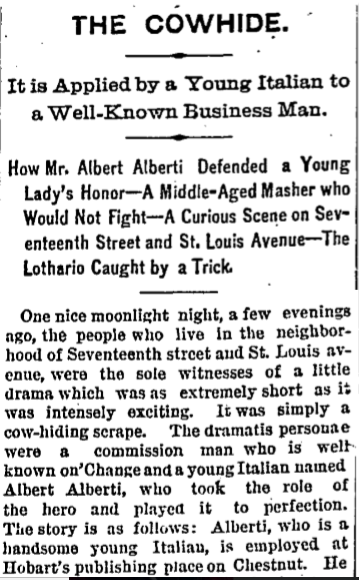
I am quickly learning the genealogy research has more brick walls than I expected. While I don’t enjoy the frustration that comes with failing to locate a desired document, it is really really cool when you find something that you weren’t looking for. What I am sharing with you today is probably my favorite find to date. This article is about Albert Alberti, from the 1883 copy of the St.Louis Post Dispatch. It details our 28 year old great grandfather defending the honor of one of his “lady friends” by horsewhipping a well known Saint Louis businessman. I can’t do it justice, and you just need to read it for yourself. It paints such a colorful picture of our ancestor! 


Click here to read the entire article

I have so many questions after reading this. Who was this woman he was defending and refused to identify? Could it have be his first wife Charlotte Block? I did find a census record for 1880 showing that at age 16 she had moved out of her father’s house and lived with her sister Kezia on 12th street. This altercation took place on 17th street, but perhaps the sisters moved a few block over by 1883. Or perhaps these “lady friends” were prostitutes. If we know one thing about Alberto for sure, he was a bit of a ladies man. Probably no way to know for sure, but this article is fantastic! I love the quotes and being able to get a feel for what Alberto’s personality and temperament were like. Can’t you just imagine this mustachioed Italian Casanova creating a scene on the muddy Saint Louis streets 135 years ago?


Thursday, September 13, 2018

Earl Returns (Reposted)


 I see that Earl has resurfaced on Facebook.  I thought he was irretrievably lost.  Those reading this blog in Kyrgyzstan might want to return to whatever it is you do in Kyrgystan, like repairing the roof of your Yurt so it doesn’t leak on your keyboard.

      There are a number of things I’ve mislaid, lost sight of, and let slip through my fingers.  I’ve lost money in the stock market, frittered away time and money on corny business ideas, and pawned my wife’s jewelry to buy shingles for the log cabin.

      For extended periods I’ve most my temper, my sanity, and sense of humor.  I’m now missing several body parts, a toe, tonsils and gall bladder.  Taking Jack Kerouac’s advice on accepting loss I’ve come to terms with all the things I no longer have, except for one.  Earl.

     I was named Guardian of Earl after the funeral of my niece, Julie, a Lieutenant Colonel assigned to the Pentagon.  Julie was a rabid fan of Far Side cartoons and Saturday Night Live.  She found Earl at the bottom of a Walmart discount barrel, took him home, and dressed him in a miniature conical party hat with a matching red ribbon around his neck.  Earl became her inseparable side-kick throughout her long military career.  Earl helped her break the ice and language barrier with children who were dreading the inoculating needle.  During Julie’s last terminal year she requested more and more goofy stories about Earl.  I may post a few in memory of Julie.  Has it been nearly eleven years already?

     The goofy stories include Earl amending Julie’s income tax to include himself as a deductible barnyard animal, building a time machine out of old Game Boy parts, communicating with Stephen Hawking on a regular basis, solving the mystery of Amelia Earhart, and if you owned any Tyson stock back in the day, Earl was the one who started the “Angry Chicken Syndrome” rumor that led to your loss.  Earl tried to short sell Tyson stock but rubber chickens lack basic math skills.

     Earl has secretly infiltrated genetic labs where they’ve been splicing DNA from Foghorn, that super-sized Leghorn, and other cartoon characters.  Earl's been an informant for PETA on a regular basis.

     The last time I saw Earl he was sitting on top of the chalkboard in my high school chemistry lab in the middle of a Superfund site in Picher Oklahoma.  My students had dressed him in a vest made of aluminum foil after he developed a fear of flying sting rays.  Twice I’ve made the trip back to Picher searching for Earl. I think the custodian's son abducted him.  I’m glad to see that Earl has made his way out of that toxic waste dump, but saddened to see that someone has tied him to the back bumper of their car as a shock absorber.  Very cruel and inhumane!

     I also need to inform NASA that Earl has traveled to the edge of the universe and found it is covered with four by eight sheets of half inch gypsum wallboard. During the trip Earl also communicated with aliens from Alpha Centauri who gave him the formula to neutralize carbon.   The most important thing Earl found in his intergalactic travel is that, just as Einstein predicted, time is cyclical.  That means that all things will come back to us in time.

Sunday, September 9, 2018

I Always thought Punky was my dog.

How I remember Punky
 That’s how I remember it.  The year after my dad crashed his plane I was playing in the sandbox beneath the big apple tree in our backyard. A little brown dog saw me and wedged his way through the white picket fence that separated our yard from Mom Hopkins yard.  You could see his ribs.  He came right to me in the sandbox.  My mom was hanging out the wash on the clothesline behind me.  The clothesline ran along the fence from the apple tree up to the garden by the chicken house. The dog didn’t have a collar. By the looks of him you could tell he was a stray.  I’d never had a dog so I asked her if  I could keep him.  I begged and pleaded!  She reluctantly gave in with the condition that I would take care of him.

I find two whole pages in my mother’s writings about “Punky.”  This is how she remembers it.

I was hanging out the wash on the line when a little brown terrier came through the picket fence and stood looking up at me.  He was so thin and weak his legs were trembling.  His eyes were pleading for help even though he was making no sound.  I left the clothes as they were and went in and fixed him a saucer of warm milk.  He became our beloved pet and we called him “Punky” 
       
There goes the memory of my “begging and pleading.”  So I guess “Punky” was not exclusively my dog although I’ll always remember him as mostly mine.  My mother writes:
 Punky became our beloved pet – He became so much a part of the family that I think he forgot he was a dog sometimes.”

In my memory “Punky” was mostly my dog for about three years, all the way to the beginning of second grade. In the beginning he was pretty timid, especially frightened of bigger dogs in the neighborhood.   My mother writes:

“When Dan heard dogs fighting or barking he would put Punky in the basement.  Several times when Dan wasn’t there I’ve seen Punky run and dive through the basement window by himself.”

I never realized my mother was such a dog lover. There’s nearly as much ink about Punky in this notebook as there is about the five children she gave birth to. Here’s a little more ink she penned on Punky.

“One day the children and Punky went up to Fairmount (2 ½ blocks) with me – I had completed my business and decided to get an ice cream cone for each of the children.  When I went outside I saw Dan feeding his to the dog.  So I got him another.  From then on I bought enough for Punky – Ice cream was his favorite treat (They were 5 or 10 cents then and very good).  I saw Punky knock a cone out of a little girls hand once.  Just now I don’t remember what I did about that.  I really felt bad.
        Another time I remember was Punky wanting to get up on the lounge – I told him no and he started crying, tears running down his face like a person.  I just sat down beside him and talked to him, but I still didn’t let him on the lounge.”

Okay, I‘ll have to fact check whether a dog can cry tears.  I concede it appears that Punky was not exclusively my dog.  I guess Punky was a family dog; my mothers’s and mine primarily.  My sisters will have to weigh in on their percentage of ownership.

Fast forward a couple of years. Punky’s rib cage had filled out on table scraps.  He never got much bigger but he got more aggressive and territorial.  He was still afraid of bigger dogs, but cars and trucks were fair game, especially big noisy trucks.  He began chasing them.  He would yip and bite at their rotating tires.  I tried to stop him but Punky had his own agenda.  A leash never crossed my mind.  A leashed dog in our blue collar neighborhood was unthinkable.

Punky finally succeeded in catching a truck, right before school, right in front of Mom Hopkins house next door.  It was a big clunking slow moving truck that Punky tangled with.  I think Mom Hopkins’s husband helped bury Punky.  I’ve never figured out why we called her Mom Hopkins.  She was no relation.

Staying home and grieving was not an option. My mother was already at work. I had tried staying home alone before. It had precipitated a lie about a man with purple shoes offering me candy. I was on the principal’s radar.

My mother writes this:
“Finally a car (truck) killed him and Dan saw it happen.  I was already at work and didn’t know until evening – His teacher said he laid on his desk and cried most of the day.”

My second grade desk was in the middle row halfway back.  I couldn’t have been more centrally located.  Teachers are woefully underpaid.  I disrupted the class beginning with the first school bell.  I stayed at my desk and cried through recess and lunch.  After about six hours of non-stop crying it was the last straw for Miss Straw.  She finally lost her patience.  Her voice had an edge to it. The voice of an exasperated Saint.

“Danny, would you please stand up and tell the class why you are crying.”

I stood up. Thinking about Punky ignited a new outburst of blubbering.  It’s impossible to talk when you’re blubbering.  Without any explanation I sat back down exhausted. I put my head on the desk, and slept until the final school bell rang.  I think Miss Straw thought I had been orphaned.

I guess it was Punky who had the last say on whose dog he was.  I cried buckets over his passing but it was mother that he came back to for a final farewell. Here’s the last paragraph my mother wrote on Punky in her notebook.

“A few days after his death I had an odd experience – I was upstairs and looked down the  steps and I thought I saw Punky, body and tail wagging with eyes shining and ‘I’m glad to see you look,’ and then nothing.”